
Supported by:

The oft-forgotten staple of fashion, Falke Eurosocks core business is the manufacturing of legwear such as socks and stockings, producing products both for their own brand and for export worldwide.
The German knitting family of Falke first started in business in 1895. Franz Falke’s casting of the first stitch marked the birth of the company, a name initially associated with yarn making which has gone on to be synonymous with exquisitely crafted socks. Martin Grobbelaar is the CEO at Falke’s Belville-headquarters and he takes us through South Africa’s importance to the company in the present day.
“Falke is a German-owned company that began in Schmallenberg in Germany’s High Sauerland District, and the decision to open up operations into South Africa was made in 1974. Initially this entailed making yarns for the carpet industry, but in the mid-80s it entered the sock manufacturing side of the market, as in Europe, and decided to make South Africa its sock manufacturing base for the Southern Hemisphere.”
Some 120 years after this first stitch in the Falke timeline, its collectives of craftsmen and women in Bellville and Pretoria truly have weaving and knitting in their blood, just like the Falke family itself all those years ago. Grobbelaar himself, an accountant by trade, joined Falke in 2003 as a cost accountant. From there he has truly worked his way up throughout the business in his own personal timeline.
“Under the leadership of the previous MD of Falke South Africa I helped to develop the export side of the business, its manager from 2004 onwards, becoming the financial manager in 2009 before being appointed CEO in 2015,” he runs down.
He is ideally placed to give us insight into Falke’s core aims. “Our main focus for the brand and for the product we make is threefold: fit, fashion and functionality. That is the promise we make to the consumer, that we are superior when it comes to the fit of the sock while every product we make under our brand actually has a function for the consumer. Finally, from a fashionability point of view we very much view ourselves as the trendsetters in this regard.”
For a company with South Africa so deeply ingrained in it, Falke has relished the challenge of evolving the business and keeping it relevant while remaining true to its roots, as Grobbelaar explains: “The face of the business has changed globally over time. In South Africa specifically the biggest change has been that we are now very much focused on producing our own branded product. Initially when the business was started in South Africa it was essentially making commodity product for some of the bigger retail chains.”
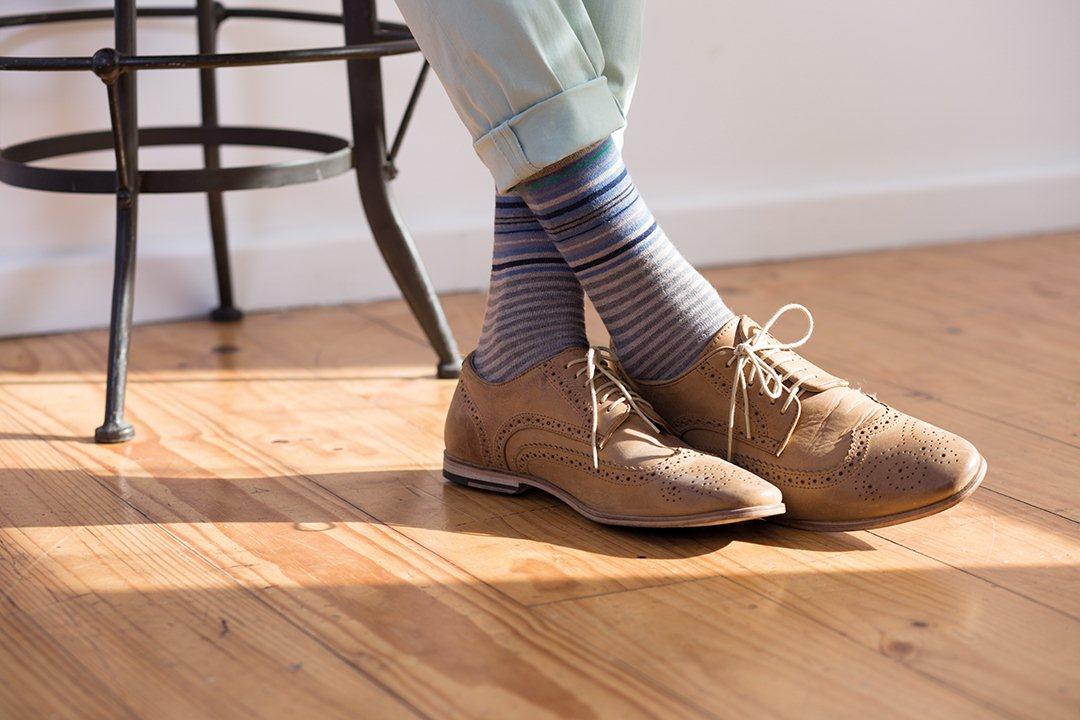
This switch of focus has brought some of Falke’s biggest successes over the past 12 months. “Our Falke brand footprint in the local market has expanded quite significantly. We are very well established in the sports market, but we’ve put a lot of research and development energy into growing our footprint in the fashion market. We’ve actually launched a new men’s fashion range alongside a new woman’s fashion sock range, which is the first time we’ve done so in South Africa.
“Because of our European heritage, the fashion side of our business has always been traditionally fairly Euro-centric, while the African market is a lot more bold and daring in terms of design and colour by comparison. The biggest challenge for us has been to truly try and understand the African market, especially with the myriad of different cultures in South Africa – to develop a range which speaks to all of them and not focus on simply one demographic in the country.
“The other great success over the last 12 months is the growth we’ve experienced in our export market. The main one of these is the USA where we’ve had growth of 14% in volume; due to the exchange rate the value increase of this has been some 40%.”
As the evocative Falke saying goes: “Every thread is a link to a common purpose,” and there has been something of a sea change in the perception of the African fashion market in recent years. Grobbelaar sees it now as representing a huge opportunity for growth. “There has been a significant change in both the South African and the broader African markets over the past 10-15 years. Traditionally, any overruns or spares from past seasons in the European and US markets – whatever couldn’t be sold essentially – would find its way to the African market. Now, the African consumer is not happy with that. We have very much become a global community and as a result the African consumers are very much aware of the global trends and want the very best.
“It is definitely still an emerging market,” he continues. “It still holds enormous opportunity, especially with the changes we have undergone over the past 20 years. Our demographic in terms of income earners has shifted toward the African population, who are very much into global brands and focused on acquiring the best, prepared to invest in brands which they find credible and which satisfy their needs.”
Falke’s commitment to aiming at the luxury goods section of its market has seen it able to swerve to a certain degree the effects of an ever-turbulent economy. “It is always a concern when issues like slow growth and unemployment are so prevalent, but we are very much pitching our brand at the top end of the market where there has been a lot of growth. Our business strategy over the past ten years has definitely been to decommoditise our brand, and by doing so we are not in direct competition with brands and manufacturers from the East especially. We are very much focused on the top 5% of the population.”
Also helping to shield Falke from the weakening Rand is its notable export footprint. “This is an advantage as it’s Dollar based,” explains Grobbelaar. “We obviously buy in a lot of our raw materials from Europe and the United States, and also from a purely manufacturing cost point of view the currency does have an impact, and so the challenge for us over the last few months has been to recover any fluctuations in the exchange rate, primarily in the local markets.
“The customers at whom we aim our brand are not so much influenced by price,” Grobbelaar goes on to explain. “It isn’t such a big barrier for them, rather they are looking for a value proposition and making sure that the brands they invest in are brands with integrity and speak to their needs.”
While it certainly positions itself at the forefront of the market, Falke is not entirely free of pressure from its competitors, particularly with the draw of cheaper labour and production to be found elsewhere in the world. “There is still competition, certainly,” declares Grobbelaar. “Obviously most of the other global brands, and most of our biggest competition brand-wise from Europe and the US undertake their manufacturing in the Far East, but their design centres are in other parts of the world. The Far East is very much focused on big volumes and commodity product, while we consciously decided to keep production local and remain a ‘quality over quantity’ company.
Falke’s are unashamedly luxury goods, then, and it follows therefore that large amounts of resources are regularly fed back into the processes behind their manufacture. “We try to invest at least 5% of our revenue every year into new equipment,” states Grobbelaar. “The dual main drives there are in the latest technology, as well as becoming more efficient in our production,” he goes on. “Additionally, we want to make sure we are always reducing the impact we have on the environment. Our commitment to our employees is to create more capacity so that we can service our markets more easily. From a technological point of view, on a global scale Falke is among the most well-served production facilities in terms of the newest available technology. Particularly on the knitting side, we have heavily invested in machinery that is more energy efficient, especially on scarce resources like electricity and water,”
Responding to what has been a topic at the forefront of people’s minds in South Africa in recent years, this move toward greener technology is a principal focus for Falke. “We are looking at solar energy as a means to fully supply our plant, which would require massive investment. At present we are very much looking at key areas where we are most energy intensive, to see how we can reduce our demands in those areas.”
Grobbelaar concludes with a look to how Falke will maintain its position as the industry leader in South Africa. “On the design side, our belief is that we need to continue to be the trendsetters. We never copy what other people do, we need to be the premium brand in our market. We will do this in various ways, through our in-house design and development centre, where we look at global trends and connect with business partners in the US, Italy and the rest of Europe through our own footprint and stay abreast of trends. By continually focussing on building our brand pillars of quality, innovation, modernity, consistency and reliability we will grow and sustain the brand in the years to come. We also bring in new people on a constant basis, to access new skills, as well as concentrating on upskilling the people we already have. We firmly believe, as part of the company culture, that while the majority of our assets depreciate over time, our people actually appreciate in value as they are up-skilled and gain experience.”